Northwest Institute Evidence
In its role as intervenor in the review of the Enbridge Northern Gateway Pipeline proposal, the Northwest Institute for Bioregional Research submitted the following three reports as evidence to be considered by the Joint Review Panel.
Final technical hearing summaries
The Hearings, Transcripts, and these Hearing Notes
The Final hearing phase with cross examination is organized such that "panels" of witnesses with expertise in issues relating to the Northern Gateway project are brought together to field questions about evidence that has been filed by them. If you wish to listen to the hearings live you can go to http://www.meetview.com/neb/. Transcripts are posted on a daily basis, as much as possible, and are available on the NEB website. Northwest Institute will review the transcripts and prepare notes for interested readers. The notes are available on this website and will be posted shortly after each hearing day.
Each session of the hearings begin with the chair’s opening remarks, registration of appearances, and administrative matters. Transcripts then list the panels of witnesses who will be presented that day, and the list of intervenors' representatives, usually lawyers, who will be examining or questioning the respective panels.
The Panel is composed of Sheila Leggett (Chair), Kenneth Bateman, Hans Matthews.
The Applicant is Northern Gateway Pipelines. Their lead counsel is Richard Neufeld.
Intervenors and their legal counsel will be introduced as they appear.
References to locations in the transcripts are by paragraph number. 1 is the first paragraph of the first transcript from Whitecourt AB on October 10, 2010. The first paragraph of the Questioning Phase of the hearing, on September 4, 2012, is 14343.
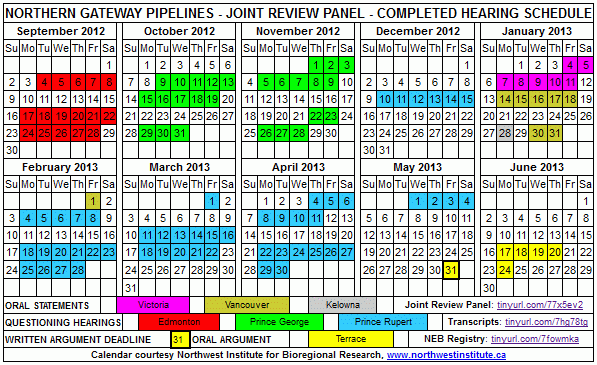
The schedule for the Final Technical Hearings was as follows. The hearings finished on June 24, 2013.
Community Hearings
Between April and July 2012 community hearings were held across northern B.C. from Haida Gwaii to Prince George. In these hearings members of the public could make 10 minute Oral Statements to the Panel. These Oral Statements were not subject to cross-examination and allowed community members to provide the Panel with their knowledge, views and concerns on the proposed Enbridge Northern Gateway Project.
Northwest Institute attended these hearings and compiled excerpts from each hearing, which can be viewed below. Community Hearings in southern B.C. took place in January and February 2013.
Enbridge Joint Review Panel
Northern Gateway Pipelines
Northern Gateway Pipelines is a proposal by Enbridge to build a pair of pipelines from Bruderheim, just outside of Edmonton, 1170 km to Kitimat, on BC's west coast. The larger pipeline would carry 525,000 barrels per day of diluted Alberta tar sands bitumen (hence, "dilbit") to Kitimat, where it would be loaded on tankers destined for Asia, California and other markets. The smaller pipeline would carry 200,000 barrels per day of imported "condensate", a liquid byproduct of natural gas processing, from Kitimat to Alberta, where it is used to dilute bitumen, so it will flow in a pipeline.
Joint Review Panel
The project is undergoing an environmental assessment (EA) and permitting process conducted by a Joint Review Panel. "Joint" refers to the fact that the Panel is charged with conducting an EA under the Canadian Environmental Assessment Act and a permitting review under the National Energy Board Act. In its review and decisions, the Panel will consider comments filed by the public, evidence filed orally and in writing by intervenors, governments, as well as the applicant.
The panel began hearing from witnesses in January 2012 with a round of oral evidence hearings where intervenors were able to give evidence orally that could not be provided in written form. This evidence is subject to cross examination in the final hearings.
In late April 2012 the community hearing phase began and hearings were held across northern B.C. In these hearings community members could make 10 minutes presentations and these were not subject to cross examination. Northwest Institute attended these hearings and compiled excerpts from each hearing, which can be viewed on our Community Hearing Summaries. Community hearings will continued in southern B.C. in January and February 2013.
The technical hearings, known as the “final hearings” began in September 2012. These hearings allow intervenors to cross examine expert witnesses put forward by the proponent, and similarly allow the applicant and other intervenors to question witnesses of the intervenors. The hearings began in Edmonton with economic issues, then moved to Prince George where the evidence focused on the construction and impacts of the pipeline, and finished in June 2013 in Prince Rupert looking at marine and First Nation issues. Northwest Institute compiled short summaries and notes from each day of hearings which can be viewed here.
In legislation enacted following the 2012 Federal Budget and Bill C-38, the government required the Panel to complete its review and submit its report by the end of 2013, and has clearly stated that it will be the "Governor in Council' (that is, the federal cabinet), which will make the final decision on the Northern Gateway project. The Panel reviewed the evidence from the hearings between June 2013 and December 2013 and arrived at its decision on December 16. The JRP recommended that the Northern Gateway project be approved with 209 conditions. The federal Cabinet must make their final decision by the end of June 2014.
Liquefied Natural Gas
The Northwest Insitute has produced a number of publications about Liquefied Natural Gas proposals in BC including a fact sheet, an analysis of greenhouse gas emissions, an up-to-date table of proposals and a request for a Strategic Environmental and Economic Assessement of BC LNG proposals.
To read these publications, visit our LNG Projects page.
Table of LNG Projects in Northwest BC
A table providing details on the proposed Liquified Natural Gas projects in Northwest British Columbia. Last updated September 2025.
Table of LNG Projects in Northwest BC
*last updated September 23, 2025
The following table provides details on proposed Liquefied Natural Gas projects in Northwest British Columbia. We will update this table as new information becomes available. Download a PDF of the table (112 KB)
Click here for a map of LNG projects in BC, created by the Wilderness Committee, January 2024.
Technical Review of the Telkwa Coal Mine Proposal
This review was conducted by Dr. Patrick Littlejohn, P.Eng., Senior Chemical/Metallurgical Engineer with Source and a Qualified Professional in BC in the area of mine water treatment and discharge planning. It provides a third party technical review of the Tenas Coal Project Environmental Assessment Certificate Application and was conducted to support the Northwest Institute during the public comment period for the Application. Download the report here.
This review was conducted with the following focus areas and questions in mind:
- Geochemical sampling program – are the mineral samples collected representative of coal ore, ore halo & waste rock? Was the geochemical testing program rigorous? How much selenium is present in project rock?
- Source control – does the Project apply appropriate Acid Rock Drainage (ARD) mitigation measures in ways that make sense and align with overall mine plan and water balance (i.e. Potentially Acid Generating (PAG) rock submergence, waste rock pile design)? What is the potential for selenium release?
- Site water balance – is site water management infrastructure robust and capable of handling a wide range of weather conditions (i.e. wet years, dry years, extreme weather events)?
- Mine contact water quality – how contaminated is mine contact water expected to be and are predictions reasonable? How sensitive are predictions to things that may be uncertain, like PAG characterization, site water balance?
- Water treatment approach and capacity – how is water treatment applied, and are water treatment goals achievable with the technologies describe? Is water treatment capacity sufficient? Will treatment address potential selenium contamination?
- Discharge location – does the project design follow BC best available technology/initial dilution zone policy?
Summary of Findings
Significant risks were identified with the Application in each of these subject areas. To summarize:
- The geochemical sampling program is not sufficiently robust to characterize the ML/ARD potential of the disturbed material. The proposed approach to MLARD management relies entirely on source control, which leaves no room for error in materials identification and handling. Significant risk of onset of acid rock drainage, neutral metal leaching and selenium contamination exists with the proposed project.
- The Application contains insufficient evidence/analysis supporting the idea that the implementation of source control is practical and can be executed under a range of climate conditions or in the context of geochemical uncertainty.
- The Application includes water management features that are designed to meet 1-in-10 year storm events. Discussion of variable climate conditions (i.e. climate change) are limited. Given that the project is to operate for over 20 years with a total lifespan including closure/post-closure of close to 50 years, use of shorter or less conservative design basis adds risk of impacts to the environment.
- Expectations of mine water quality are optimistic and do not entertain the possibility of onset of ARD if any aspect of the mine plan does not go according to plan (i.e. mishandling of PAG material, failure of source control measures, higher than expected geochemical source terms, or flushing of oxidation products prior to material submergence).
- Water treatment is not included in the application. Any contamination that occurs in mine contact water is proposed to be released directly to the receiving environment without treatment. This is a significant deviation from best practices in BC and represents a major risk to the downstream environment.
- The Application proposes site specific water quality targets that are significantly less conservative than BC’s generic guidelines using a process that does not align with BC’s policy. The Application does not include use of Best Available Technology to prevent contamination and so does not follow BC policy on initial dilution zones.
Overall, the project design is predicated on an optimistic interpretation of limited geochemical data and the ability to execute a mine waste and water management strategy with little margin for error. Modeling conducted by the proponent indicates that they expect the immediate receiving environment to be degraded with mine-borne contaminants including a 200 fold increase in selenium concentration in local creeks. The project does not follow BC policy on application of Best Available Technology to prevent contamination in the downstream environment. All of these factors mean that there is significant risk of the project having both short and long term negative impacts on water quality in the downstream environment.
Open letter: Allow public input on Enbridge’s fracked gas pipeline extension application
March 21, 2023
The Honourable George Heyman
BC Minister of Environment and Climate Change Strategy
Via email: [email protected]
Open letter: Allow public input on Enbridge’s fracked gas pipeline extension application
DOWNLOAD THE LETTER HERE
Dear Minister Heyman,
We, the undersigned organizations, write to express our concern regarding the environmental implications and lack of public input on the decision-making process to extend the Westcoast Connector Gas Transmission (WCGT) pipeline certificate. Enbridge Inc.’s application to push the deadline to start building the pipeline for another five years, until November 2029, and the process for granting this extension deserves to be informed by the people and communities who will be impacted.
First approved in 2014 and already receiving a five-year extension in 2019, the WCGT pipeline would transport fracked gas from northeastern B.C. to a liquified natural gas (LNG) facility near Prince Rupert. It will cross over 700km of valuable and irreplaceable ecosystems, including the critical habitat of the woodland caribou - listed as a ‘threatened’ species under the federal Species at Risk Act - as well as hundreds of salmon-bearing streams in the Fraser and Skeena watersheds. It will cross the territories of several Indigenous nations and communities, many of whom have not provided consent to this project. We continue to witness, with Coastal GasLink, how a fracked gas pipeline can trample on Indigenous rights and accrue violation after violation of its environmental assessment permit.
The WCGT pipeline will have significant implications for the achievement of B.C.’s climate targets and our efforts to address climate change. The original project assessment report states that the construction of the pipeline will produce up to 2.5 million tonnes (Mt) of greenhouse gas (GHG) emissions while operations will add up to 4.4 Mt of GHGs annually. B.C. is already failing to meet our emissions targets and a project of this scale will put our climate goals even further out of reach.
The direct emissions from the project are only a fraction of its broader implications. The pipeline will facilitate further emissions by enabling expansion of the fracking industry in northeast B.C. and new LNG terminals on B.C.’s north coast. Fracking is already B.C.’s largest source of GHG emissions, yet we still don’t know just how significant these emissions are given that B.C. significantly undercounts methane.
What we do know is that LNG terminals are set to become the biggest point-source emitters of GHGs in B.C. Electrifying these facilities would reduce emissions but remains a pipe dream given that B.C. does not have enough electricity to do so. The Ksi Lisims LNG facility, which is undergoing environmental assessment and is considering using the WCGT pipeline, will either produce 1.9 Mt of GHGs a year or use up 5,000 GWh of electricity per year – the generating capacity of another Site C dam. There is no simple way around the GHG implications of these projects.
It gets worse. There will be massive emissions from the eventual combustion of the fracked gas that the WCGT pipeline helps make possible. The fracked gas that this pipeline can transport at full capacity (8.4 bcf/day) would produce about 162 Mt of GHGs a year, which is 2.5 times more than the entire province of B.C. emitted in 2020. B.C. should not become an exporter of climate catastrophe.
The project has had 10 years to make a start but has failed to do so. In this time, the world has changed drastically. The urgency of the climate crisis is now crystal clear, as people in B.C. bear the brunt of increasing forest fires, heat waves, and floods of unprecedented magnitude. As Premier Eby stated in his first speech as premier: “We cannot continue to expand fossil fuel infrastructure and hit our climate goals.” The world is turning away from fossil fuels – including so-called “bridge fuels” like fracked gas – at an increasing pace. Further, we do not accept any more massive infrastructure projects that violate Indigenous rights and harm our lands.
Therefore, we request that you establish a public comment period for both decisions relevant to Enbridge’s emergency extension application: 1) whether to vary the Environmental Assessment Act (“Act”) to allow this extension to be considered and 2) whether to grant the extension.
As this is the project’s second extension request, the Act must first be varied to allow an extension to be considered. The variance must be shown to be necessary due to an emergency and be in the public interest. A robust, informed decision on whether Enbridge was actually delayed due to an emergency and whether a variation is in the public interest can only be made by hearing from the public.
If a variation is granted, the public must also be consulted on whether or not to give Enbridge another five years to build its pipeline. We’re sure that the public will have plenty to share on this subject.
In 2021, when the KSM Mine asked for emergency extension of its own, the B.C. Environmental Assessment Office held a public engagement process on both the variation decision and the extension decision. The reasons for both decisions referred to the information gathered from the public. The Minister’s reasons stated that “I would expect the EAO…to follow a similarly rigorous process” for future emergency extension requests.
We are asking that you establish such a process now, starting with a public comment period for the variance decision.
Sincerely,
Pat Moss
Executive Director, Northwest Institute
Babine River Foundation
Carrie Collingwood, Director
Canadian Association of Physicians for the Environment
Melissa Lem, President
Citizen's Oil & Gas Council
Mike Sawyer, Executive Director
Climate Justice Victoria
Eric Doherty, Director
Communities Against Supertankers
Valine Brown, Director
Council of Canadians, Campbell River
Richard Hagensen, Chairperson
Council of Canadians, Nelson/West Kootenay
Sandra Hartline
Council of Canadians, Terrace Chapter
Dave Shannon, Climate & Energy Chair
Council of Canadians, Victoria Chapter
Barbara Mitchell-Pollock, Co-chair
David Suzuki Foundation
John Young, Energy Transition Strategist & BC LNG Campaign Lead
Dogwood
Kai Nagata, Communications Director
Douglas Channel Watch
Cheryl Brown, Chair
Friends of Wild Salmon Coalition
Des Nobels, Past chair
Georgia Strait Alliance
Christianne Wilhelmson, Executive Director
Gidimt’en Checkpoint
Eve Saint, Divestment Financial Campaigner
Greenpeace
Keith Stewart, Senior Energy Strategist
Northwest Watch
Anne Hill, Chair
Shift Action for Pension Wealth and Planet Health
Patrick DeRochie, Senior Manager
SkeenaWild
Greg Knox, Executive Director
STAND Earth
Sven Biggs, Canadian Oil and Gas Program Director
T. Buck Suzuki Foundation
Alaina Pyde, North Coast Campaigner
West Coast Environmental Law
Gavin Smith, Staff Lawyer
Wilderness Committee
Peter McCartney
Cc: Premier Eby
Cost Benefit Analysis of the Telkwa Coal Mine Proposal
On behalf of the Northwest Institute, Swift Creek Consulting has prepared an assessment of the Telkwa Coal Mine's net economic benefits and comment on the Project’s public interest case. Economic benefits play an out-sized role in public interest evaluations, and therefore it is crucial to closely examine economic net benefits so that the BC government is properly informed. Download the report here.
Critical Review of the Telkwa Coal Mine Socio-Economic Assessment
This report provides a critical review of the socio-economic components of the environmental impact assessment prepared for the proposed Tenas (Telkwa) coal project, which would be located seven kilometres southwest of Telkwa. It includes an analysis of project need and benefits, and economic, demographic, infrastructure and methodological issues.
Telkwa Coal Mine Plan - Key Issues Related to Water
Telkwa Coal Mine Plan – Key Issues
_______________________________________________________
By Patrick Littlejohn, PhD, P.Eng for the Northwest Institute June 21, 2022
These comments are based on a preliminary review of the Telkwa Coal Mine application by Patrick Littlejohn, PhD, P.Eng., a mining professional with more than ten years of experience in mine water treatment and management in BC. He will conduct a more fulsome review and contribute written comments to the Northwest Institute as part of the Environmental Assessment process.
1. Lack of appropriate water treatment: The project proposes very limited water treatment to remove suspended solids (i.e. dirt/sand particulate) and does not propose treatment of any dissolved solids in water. This does not align with BC policy on use of Best Available Technology and use of Initial Dilution Zones. Basically this policy says that if a mine expects to have contaminated water, the mine owner needs to use Best Available Technology to treat it before considering potential impacts to the environment. There is reasonable potential for water contamination from selenium and acid rock drainage. These are fairly common issues in the mining sector and there is lots of precedent in BC and elsewhere for treatment of mine water for these kinds of contamination. The project discusses active water treatment as a contingency measure but this should be part of Plan A.
2. Relaxation of water quality standards: BC has generic water quality guidelines to protect the environment. The project proposes to use relaxed water quality standards for selenium that are 4 to 17 times higher than BC’s standard guidance. Project specific water quality guidelines can be developed if there is a firm scientific basis for why the generic standard is inappropriate for a specific site and BC has detailed policy guidance on this process. Based on my preliminary review, the Tenas project does not appear to follow the policy for development of a Science Based Environmental Benchmark and so their basis for relaxing water quality guidelines for the project is questionable.
3. Optimistic design: Overall, the mine plan proposal paints an optimistic picture in terms of managing water and preventing contamination. Even the best mine plan can have problems – maybe there is more or less rain than anticipated, maybe economic conditions change and the mine goes on temporary closure, maybe source control doesn’t work well enough to prevent contamination, maybe there is more contamination released from rock than anticipated. The project application describes a mine plan that could work if everything goes perfectly. However, mines never go exactly as planned and so best practice is to have robust designs that incorporate redundancy to mitigate risks and prevent impacts.
In short:
• The mine plan does not follow BC policy with respect to water treatment.
• The mine plan proposes to use BC water quality standards that are significantly higher than BC’s generic limits.
• The project design does not seem robust enough to proactively manage risk to the environment.
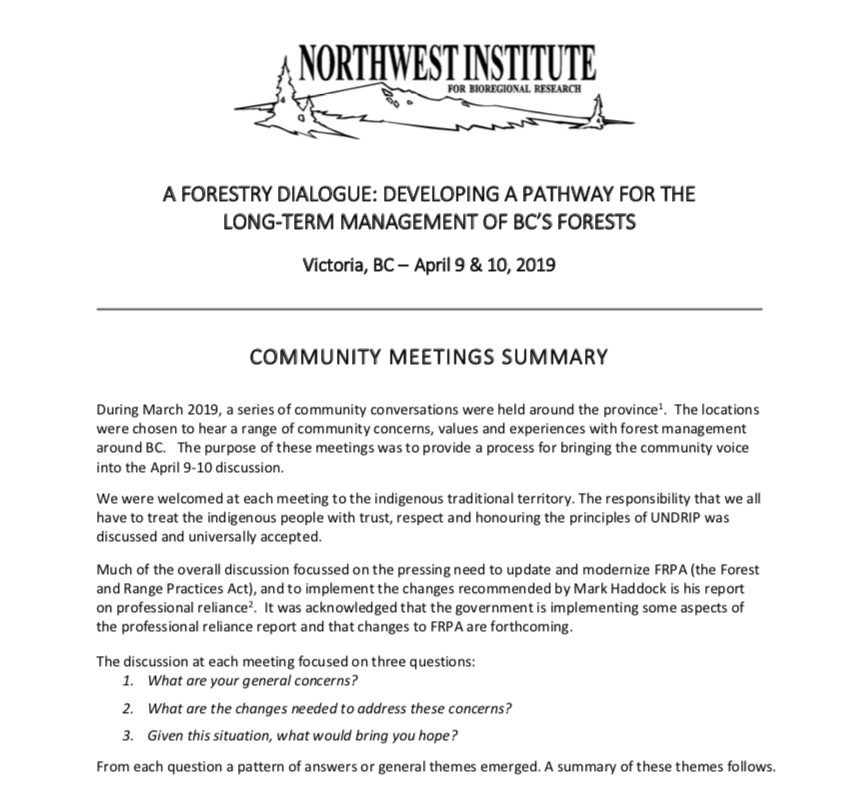
Forestry Dialogue
April 9-10, 2019
Background
As a consequence of the May 2018 Professional Reliance review report the conversation on the state of the forests and their management was revitalized. The professional reliance recommendations called for and are bringing forward a broad, renewed call for change in BC’s approach to forest management.
The current government in its election platform, and subsequently in their mandate letters, made a commitment to address such critical matters as: species legislation, reconciliation, environmental assessment, land and water use planning, wildlife habitat management, and water sustainability. However, each of these initiatives is underlain by the need for diverse and ecologically healthy forests, and without broad forestry reform will be largely unsuccessful.
Recently a number of government initiatives directed to updating FRPA’s legal and policy framework are moving forward. As well there are other opportunities to build on, such as: the activities of the Forest and Range Practices Advisory Committee, the Coastal and Interior Revitalization Initiatives, First Nation reconciliation and the Green-NDP CASA Agreement.
However, it remains unclear how, or if, the current government will change the long-term management of BC’s forests. As well the current initiatives are being done in a vacuum as a long-term vision is lacking.
There is therefore a growing recognition by a wide-range of organizations that now is a good opportunity to begin the change needed to reform forest management in BC; and to develop a long-term vision for a more holistic approach to the management of the forest environment and our natural resources.
This forest Dialogue was suggested as one method for moving this vision and conversation forward.
Process
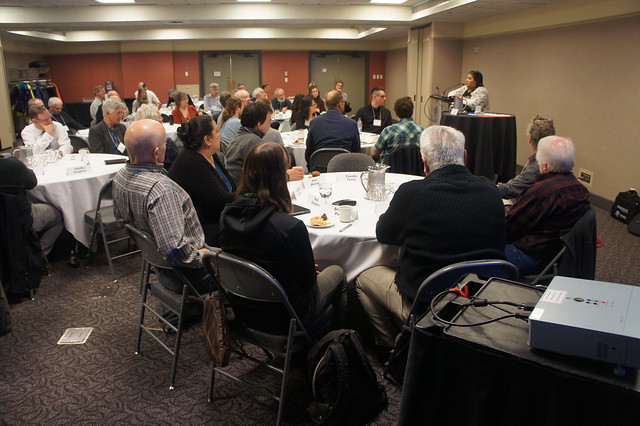
The Dialogue was organized by the Northwest Institute for Bioregional Research, with funding support from Tides Canada. The gathering was designed more as a dialogue than a traditional conference. Attendance was limited to ~65 people who understood and supported the purposes. Attendees were a diverse range of influential individuals representing First Nations, university, organizations, NGO’s, unions and business from throughout the province. Minister Doug Donaldson spoke at Noon on April 10th. Other speakers were Dean John Innes UBC Forestry, Mayor Bob Simpson from Quesnel, Dr. Jim Pojar retired forest ecologist and Joel Starlund, Executive Director of the Gitanyow Hereditary Chiefs.
Download a Summary of the April 9-10 Dialogue
Prior to April 9-10, a series of community discussions focusing on key local concerns were held with a variety of community representatives from around the province. Feedback from these discussions helped frame the approach to the April Dialogue.
Download a Summary of the Community Discussions
Victoria Gathering Photo Album
Presentations
Following are the presentations that the five key speakers delivered at the Dialogue, both video and their accompanying powerpoint. (Video portion coming mid May 2019)
The Academic Perspective
Dr. John Innes, Dean UBC Faculty of Forestry
Download PDF
View Video
The Indigenous Perspective
Joel Starlund/Sk’a’nism Tsa ‘Win’Giit, Executive Director Gitanyow Hereditary Chiefs
Download PDF
View Video

The Ecological Perspective
Jim Pojar Ph.D., R.P.Bio., Senior Ecologist (ESA)
Download PDF
View Video
The Community Perspective
Bob Simpson, Mayor City of Quesnel
Download PDF
View Video
The Government Perspective
Hon. Doug Donaldson, Minister of Forests, Lands and Natural Resource Operations, and
Rural Development
View Video
These four documents were provided to read before attending.
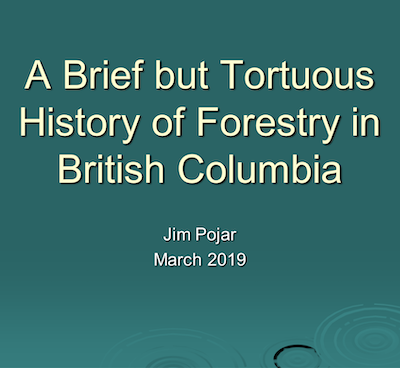
A Brief and Torturous History of Forestry in British Columbia
Dr. Jim Pojar, 2019. This document was developed by Jim specifically as a background piece for the Forest Dialogue. It contains a storehouse of historical knowledge.
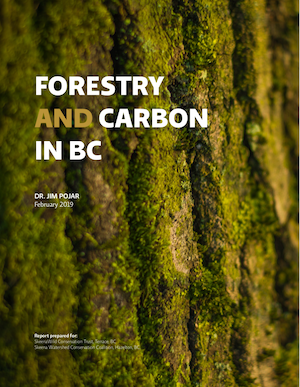
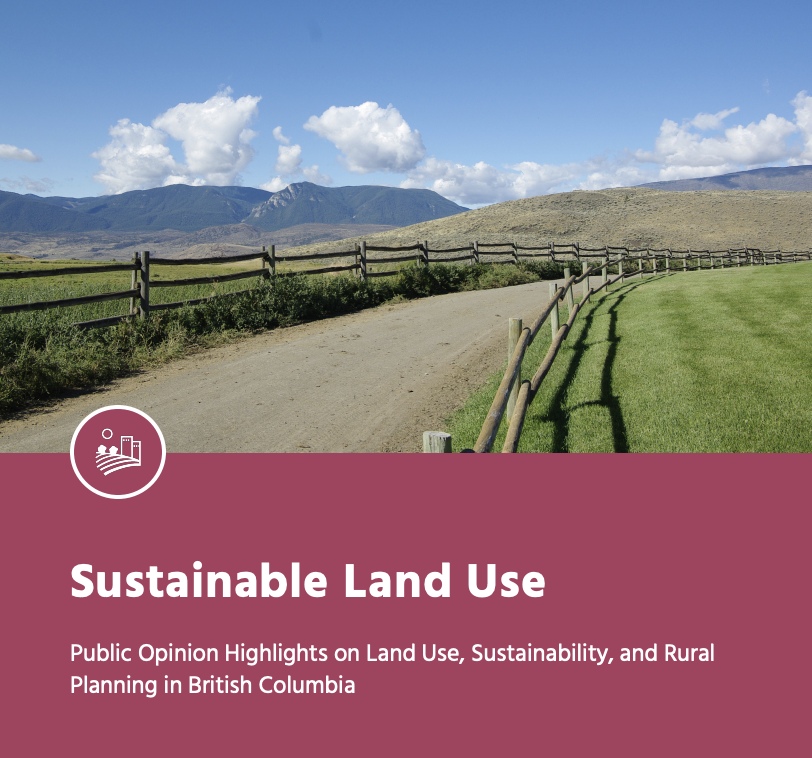
A Sustainable Land Use Public Opinion Poll
Prepared by the Real Estate Foundation, 2019.
These references were provided for general context:
Healthy Forests-Healthy Communities by Bill Bourgeois. Visit website
Restoring Forestry in BC: The story of the industry's decline and the case for regional management. Bob Williams January 2018. Visit website
Professional Reliance Review. Mark Haddock, 2018. Download PDF
A New Climate for Conservation: Nature, Carbon and Climate Change in British Columbia. Dr. Jim Pojar, 2010. Download PDF
Taking Nature's Pulse: The Status of Biodiversity in BC. 2008. Visit website
Telkwa Coal
Content here
Rio Tinto Alcan Environmental Appeal Board Hearing Summaries April - June 2015
Two outdoors-loving Kitimat teachers, Lis Stannus and Emily Towes, have launched a case with the Environmental Appeal Board against the Ministry of Environment (MOE). The two appellants are challenging MOE’s decision to allow Rio Tinto Alcan to increase its sulphur dioxide emissions from its Kitimat aluminum smelter by 55 percent above current permit levels. Even more, MOE is allowing this without the any scrubbers installed at the smelter. Emily and Lis both suffer from asthma, and both teachers are concerned about their students’ health and worried about the effects of the increased emissions on the forests and waterways of the Kitimat-Terrace valley.
The hearings are expected to take four weeks. The first two weeks of hearings will be held in Victoria from April 27 -May 1 and from May 11-15. Then there will be two weeks of hearings in Kitimat from June 1-5 and June 8-12.
Hearing Summaries
Victoria, April 27 2015, Day 1
Victoria, April 28-29 2015, Day 2 and 3
Victoria, April 30 2015, Day 4
Victoria, May 11-12 2015, Day 6 and 7
Victoria, May 14-15 2015, Day 9 and 10
Kitimat, June 11-12, Day 19-20
Victoria, June 29-30, Final Argument
A Clear Look at BC LNG: Energy security, environmental implications and economic potential
Liquefied natural gas (LNG) exports from the west coast of Canada have been heralded as economic salvation for the province of British Columbia.This report by David Hughes undertakes a reality check that reveals several major problems with this narrative, both in the stewardship of finite non-renewable resources by provincial and federal governments, and in the environmental implications of large-scale development.
David Hughes toured Northwest BC in April 2015 and discussed the content of this report with local governments and the public.
View the report below or download the PDF (811 KB).
BC LNG Myths and Realities Tour with Geoscientist David Hughes
From April 13-17 2015, geoscientist David Hughes travelled from Prince Rupert to Prince George, meeting with local governments and offering public presentations. He shared his analysis of BC's gas supply and what he sees of the province's energy future.
His presentation warned that meeting the BC government's plans for LNG development will require 37,000 new gas wells to be drilled in northeastern BC and is unrealistic given that proven, recoverable resources are much lower than what the government is projecting.
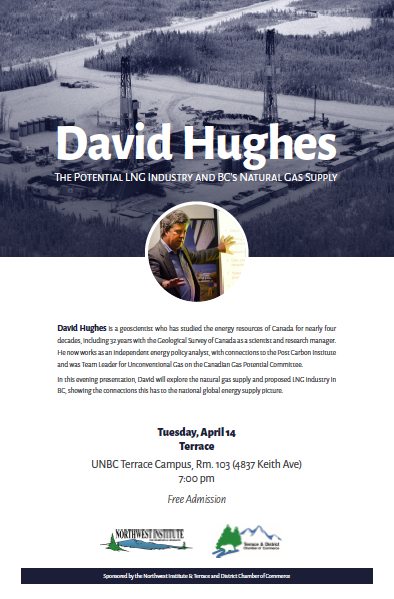
View his presentation slides below or download a PDF (19.4 MB).
Watch David Hughes' presentation on YouTube.
LNG Community Dialogue Sessions
The Northwest Institute, in collaboration with West Coast Environmental Law, is pleased to co-host LNG Community Dialogue Sessions throughout Northern BC from December 2014 to March 2015. The dialogue sessions are an opportunity to identify shared values that must be protected when considering LNG projects in Northern BC.
Our not-for-profit organizations, alongside many local governments and First Nations, have been encouraging the provincial government to undertake a big picture “regional strategic environmental assessment” that would consider the combined impacts of LNG proposals on the things we all value.
The dialogue sessions will bring concerned citizens and organizations together with neighbouring First Nations to share information and begin to tackle the tough questions ourselves: What range of development scenarios are really plausible? What are the core values that must be protected when considering industrial development, such as pipelines across BC and LNG plants on the coast? How do we make wise decisions about the right pace and scale of development for our communities?
Click here for more information.
The first session was held in Prince Rupert on December 11, 2014. Future dates and locations are to be announced. Stay informed about upcoming events here.
Brochure: What you need to know about Petronas and its impacts on Skeena Salmon
This brochure provides an overview of the impacts that Petronas' proposed Pacific Northwest LNG facility poses to juvenile salmon habitat in the Skeena Estuary. It was created in November 2014 and distributed widely to communities in the Skeena watershed. View the document below or download the PDF here (3.2 MB).
Brochure: What you need to know about Petronas and its impacts on Skeena Salmon
This brochure provides an overview of the impacts that Petronas' proposed Pacific Northwest LNG facility poses to juvenile salmon habitat in the Skeena Estuary. It was created in November 2014 and distributed widely to communities in the Skeena watershed.
Brochure: LNG in Northwest BC
This publication provides an overview of proposed LNG projects in Northwest BC and takes a close look at air pollution in Kitimat/Terrace and salmon impacts in the Skeena Estuary. It was produced in May 2014 and distributed widely across the region from Haida Gwaii to Burns Lake. View the brochure below or download the PDF here (337 KB).
Brochure: LNG in Northwest BC
This publication provides an overview of proposed LNG projects in Northwest BC and takes a close look at air pollution in Kitimat/Terrace and salmon impacts in the Skeena Estuary. It was produced in May 2014 and distributed widely across the region from Haida Gwaii to Burns Lake.
Brochure: Comparing the BC government findings on Enbridge to the Joint Review Panel’s final report
This pamphlet provides a brief comparison of the BC government's final submission to the Joint Review Panel and the Joint Review Panel's recommendation. It also highlights critical information regarding the behaviour of diluted bitumen in water, and impacts to humpback whale habitat that were not included in the review.
View the document below or download it here (3.9 MB)
Comparison of the BC government’s submission on Enbridge and the JRP’s recommendation
This pamphlet provides a brief comparison of the BC government's final submission to the Joint Review Panel and the Joint Review Panel's recommendation. It also highlights critical information regarding the behaviour of diluted bitumen in water, and impacts to humpback whale habitat that were not included in the review.
Download the pamphlet (3.9 MB)
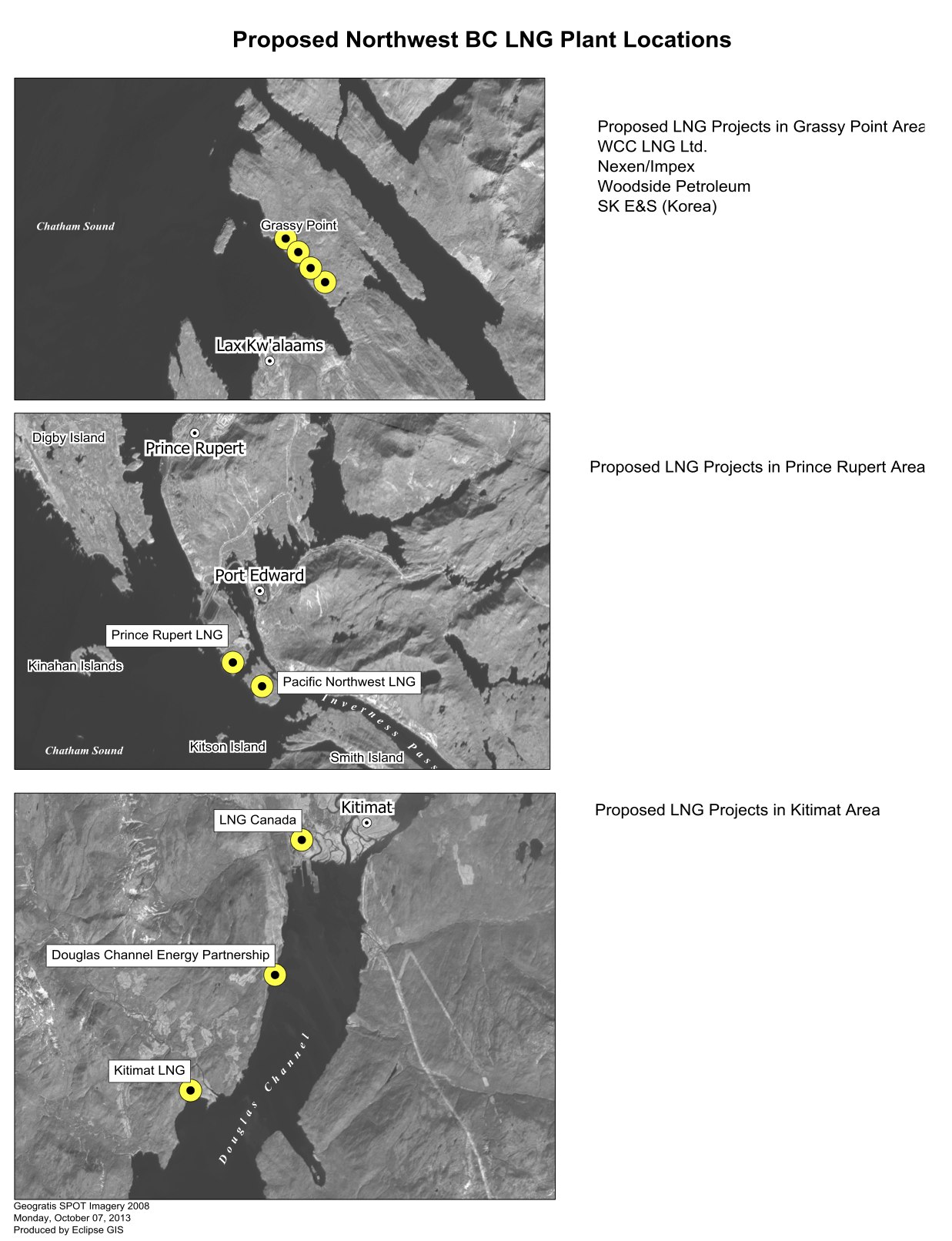
LNG Pipeline and Facility Maps
*Maps produced in October, 2013. Information is subject to change.
A more current map is available here, created by the Wilderness Committee in January 2024.
Request for a Strategic Environmental and Economic Assessment of BC LNG Proposals
The following report and media release from the Northwest Institute and UVic Environmental Law Centre call on the federal and BC Ministers of Environment to establish a Strategic Economic and Environmental Assessment of proposed massive new BC LNG developments. Acting for the Northwest Institute for Bioregional Research, the Centre proposes a careful examination of a dozen or more new LNG proposals, thousands of related new gas wells, the potential for numerous redundant cross-provincial pipelines, and the resulting risks to water, air, fish, grizzly, caribou, and human health.
Report: BC LNG Proposals and Greenhouse Gas Emissions
With an increasing number of LNG projects being announced on B.C.’s coast, it is important to balance the economic arguments of these announcements with the associated risks. The emissions from LNG projects and the impact to B.C.’s climate targets are still unclear, but based on initial modeling done by the Pembina Institute using projected volumes of LNG, it is clear that even modest development will have a material impact to the overall emissions in the province. Three questions are addressed in this memo to provide context to the LNG debate and attempt to quantify the impacts based on currently available information.
Liquefied Natural Gas Fact Sheet
This Northwest Institute publication provides an overview of the Liquefied Natural Gas development process and the LNG projects currently proposed in Northern British Columbia. Please note that the table in the fact sheet was last updated in February, 2014 and is subject to change. For an up-to-date table of proposals please go here.
Download Fact Sheet (1.0 MB)
Prince Rupert, May 1st, Day 91
Please see the following document or download the PDF (88 Kb)
Prince Rupert, Apr. 30th, Day 90
Please see the following document or download the PDF (88 Kb)
Prince Rupert, Apr. 29th, Day 89
Please see the following document or download the PDF (270 Kb)
Prince Rupert, April 27th, Day 88
Please see the following document or download the PDF (90 Kb)
Prince Rupert, April 26th, Day 87
Please see the following document or download the PDF (299 Kb)
Prince Rupert, Apr. 25th, Day 86
Please see the following document or download the PDF (98 Kb)
Prince Rupert, April 24th, Day 85
Please see the following document or download the PDF (100 Kb)
Prince Rupert, April 23rd, Day 84
Please see the following document or download the PDF (128 Kb)
Prince Rupert, Apr. 22nd, Day 83
Please see the following document or download the PDF (190 Kb)
Prince Rupert, April 11th, Day 82
Please see the following document or download the PDF (65 Kb)
Prince Rupert, April 10th, Day 81
Please see the following document or download the PDF (212 Kb)
Documenting the Enbridge Joint Review Panel Hearings
If built, the proposed Enbridge Northern Gateway Pipeline would carry diluted bitumen from the Alberta oil sands westward to a new tanker port at Kitimat, and carry condensate (a bitumen diluent) eastward to Alberta. The issue is of critical concern to Northwest British Columbians and people from across Canada. Currently, the proposed project is being reviewed by a Joint Review Panel headed by the National Energy Board. The panel travelled throughout Northwest B.C. and elsewhere in B.C. and Alberta to hear from citizens on the matter. The Northwest Institute documented the hearings throughout the Joint Review process.
To read summaries of the community and technical hearings, visit our Enbridge Joint Review Panel page.
Prince Rupert, Apr. 9th, Day 80
Please see the following document or download the PDF (111 Kb)
Prince Rupert, Apr. 8th, Day 79
Please see the following document or download the PDF (117 Kb)
Prince Rupert, April 6th, Day 78
Please see the following document or download the PDF (108 Kb)
Prince Rupert, April 5th, Day 77
Please see the following document or download the PDF (129 Kb)
Prince Rupert, April 4, Day 76
NWI Hearing Notes, Day 76 by Northwest Institute
Prince Rupert, Mar. 22nd, Day 75
Please see the following document or download the PDF (82 Kb)
Prince Rupert, Mar. 21st, Day 74
Please see the following document or download the PDF (79 Kb)
Prince Rupert, Mar. 20th, Day 73
Please see the following document or download the PDF (67 Kb)
Prince Rupert, Mar. 19th, Day 72
Please see the following document or download the PDF (185 Kb)
Prince Rupert, Mar. 18th, Day 71
Please see the following document or download the PDF (182 Kb)
Prince Rupert, Mar. 16th, Day 70
Please see the following document or download the PDF (189 Kb)
Prince Rupert, Mar. 15th, Day 69
Please see the following document or download the PDF (85 Kb)
Prince Rupert, Mar. 14th, Day 68
Please see the following document or download the PDF (86 KB)
Prince Rupert, Mar. 13th, Day 67
Please see the following document or download the PDF (767 Kb)
Prince Rupert, Mar. 12th, Day 66
Please see the following document or download the PDF (100 Kb)
Prince Rupert, Mar. 11th, Day 65
Please see the following summary or download the PDF (260 Kb)
Prince Rupert, Mar. 1st, Day 64
Please see the following document or download the PDF (90 Kb)
Prince Rupert, Feb. 27th, Day 62
Please see the following document or download the PDF (91 Kb)
Prince Rupert, Feb. 26th, Day 61
Please see the following document or download the PDF (187 Kb)
Prince Rupert, Feb. 25th, Day 60
Please see the following document or download the PDF (87 Kb)
Prince Rupert, Feb. 23rd, Day 59
Please see the following document or download the PDF (73 Kb)
Prince Rupert, Feb. 22nd, Day 58
Please see the following document or download the PDF (89 Kb)
Prince Rupert, Feb. 21st, Day 57
Please see the following document or download the PDF (85 Kb)
Prince Rupert, Feb. 20th, Day 56
Please see the following document or download the PDF (77 Kb)
Prince Rupert, Feb. 18th, Day 54
Please see the following document or download the PDF (312 Kb)
Prince Rupert, Feb. 8th, Day 53
Please see the following document or download the PDF (81 Kb)
Prince Rupert, Feb. 7th, Day 52
Please see the following document or download the PDF (221 Kb)
Prince Rupert, Feb. 6th, Day 51
Please see the following document or download the PDF (83 Kb)
Prince Rupert, Feb. 5th, Day 50
Please see the following summary or download the PDF (800 Kb)
Prince Rupert, Feb. 4th, Day 49
Please see the following document or download the PDF (480 Kb)
Prince Rupert, Dec. 14th, Day 47
Please see the following document or download the PDF (370 Kb)
Prince Rupert, Dec. 13th, Day 46
Please see the following document or download the PDF (784 Kb)
Prince Rupert, Dec. 15th, Day 48
Please see the following document or download the PDF (216 Kb)
Prince Rupert, Dec. 12th, Day 45
Please see the following document or download the PDF (322 Kb)
Prince Rupert, Dec. 11th, Day 44
Please see the following document or download the PDF (271Kb)
Prince Rupert, Dec. 10th, Day 43
Please see the following document or download the PDF (225 Kb)
Prince George, Nov. 28th, Day 42
Please see the following document or download the PDF (76Kb)
Prince George, Nov. 27th, Day 41
Please see the following document or download the PDF (136Kb)
Prince George, Nov. 26th, Day 40
Please see the following document or download the PDF (79Kb)
Prince George, Nov. 23rd, Day 39
Please see the following document or download the PDF (111Kb)
Prince George, Nov. 22nd, Day 38
Please see the following document or download the PDF (105Kb)
Prince George, Nov. 9th, Day 37
Please see the following document or download the PDF (174Kb)
Prince George, Nov. 8th, Day 36
Please see the following document or download the PDF (73Kb)
Prince George, Nov. 7th, Day 35
Please see the following document or download the PDF (78Kb)
Prince George, Nov. 6th, Day 34
Please see the following document or download the PDF (80Kb)
Prince George, Nov. 5th, Day 33
Please see the following document or download the PDF (67Kb)
Prince George, Nov. 3rd, Day 32
Please see the following document or download the PDF (1.2Mb)
Prince George, Nov. 2nd, Day 31
Please see the following document or download the PDF (81Kb)
Prince George, Nov. 1st, Day 30
Please see the following document or download the PDF (66Kb)
Prince George, Oct. 31st, Day 29
Please see the following document or download the PDF (226Kb)
Prince George, Oct. 30th, Day 28
Please see the following document or download the PDF (210Kb)
Prince George, Oct. 29th, Day 27
Please see the following document or download the PDF (159Kb)
Prince George, Oct.19th, Day 26
Please see the following document or download the PDF (123Kb)
Prince George, Oct.18th, Day 25
Please see the following document or download the PDF (64Kb)
Prince George, Oct. 17th, Day 24
Please see the following document or download the PDF (65Kb)
Prince George, Oct.16th, Day 23
Please see the following document or download the PDF (93Kb)
Prince George, Oct. 15th, Day 22
Please see the following document or download the PDF (68Kb)
Prince George, Oct. 14th, Day 21
Please see the following document or download the PDF (110Kb)
Prince George, Oct.12th, Day 20
Please see the following document or download the PDF (438Kb)
Prince George, Oct.11th, Day 19
Please see the following document or download the PDF (318Kb)

.jpg)